

Product Description
Product Introduction 1. Working voltage: DC2.5-5.5V 2. Working voltage: 1A or more 3. Output power: 3-5W 4. Load range: Impedance 2Q-8Ω It is recommended to match 3W4R speakers |
| Widely used: Suitable for college students, engineers, technicians, etc. |
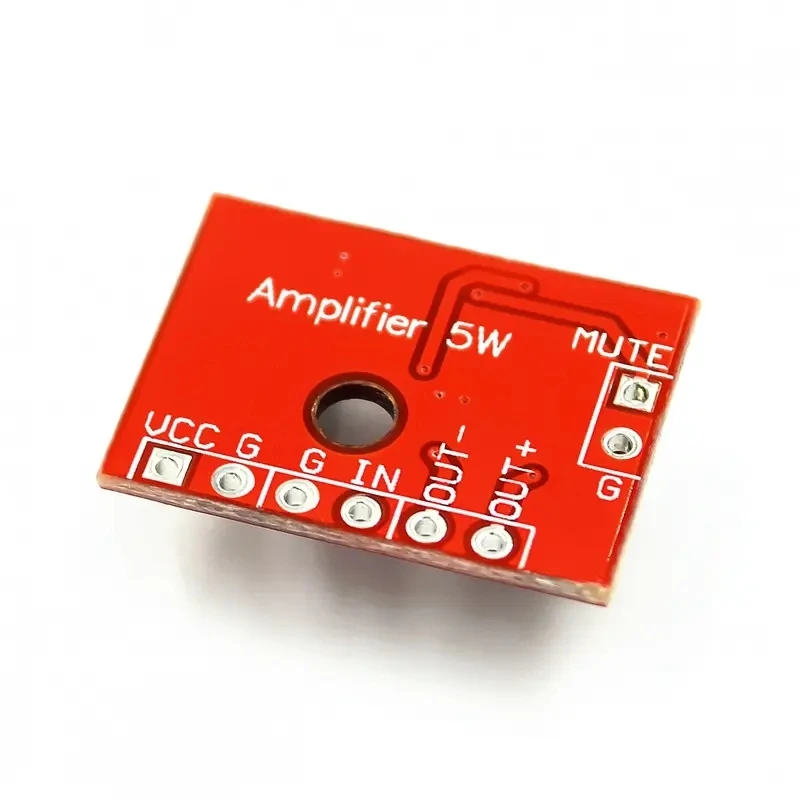
Interface definition VCC: DC2.5-5.5V (5V recommended) G: Power ground/audio ground (shared) IN: Audio input + OUT+: Speaker + OUT+: Speaker - (4-8) 3W4R speaker is recommended |
Notes 1. Please strictly install the wiring diagram 2. Do not connect the power supply in reverse, otherwise the IC will burn out 3. Please use a 2.5-5.5V DC power supply, not an AC power supply or a power supply higher than 5.5V. It is recommended to use a DC 5V 4. The power supply current is above 1A |
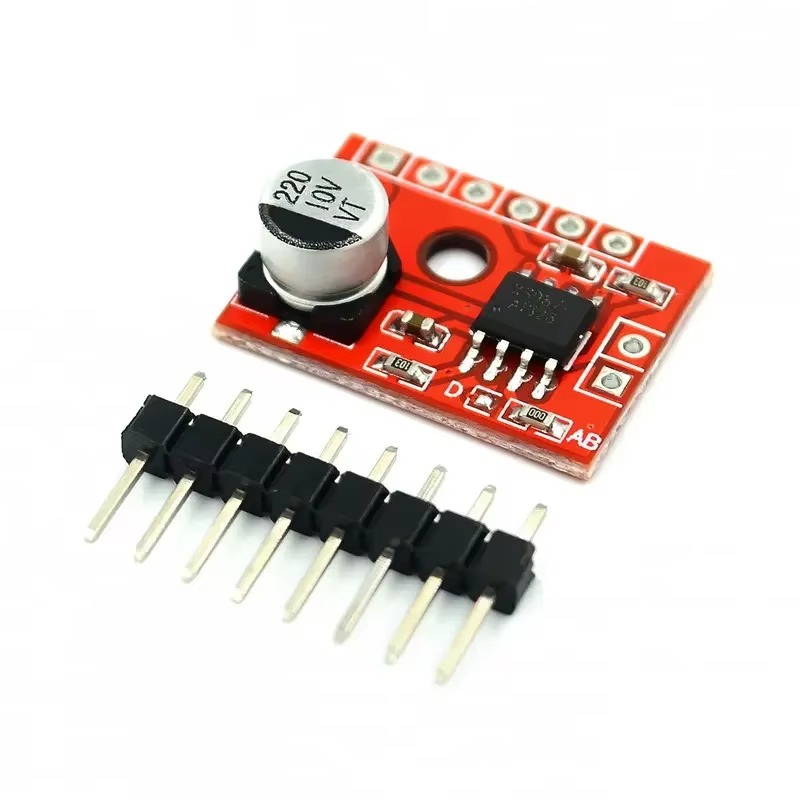
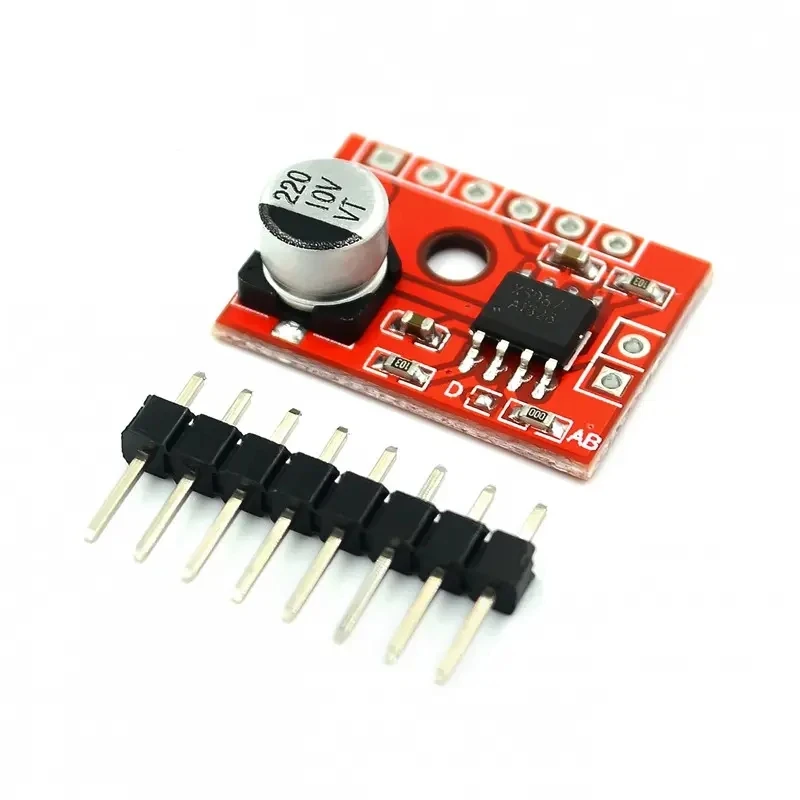
Actual image of the product
Product FAQ
1. Is there noise on the amplifier board? |
1. Poor power supply filtering is caused by AC ripple. Increasing the filter capacitor can basically solve the problem. 2. The sound source itself has noise. It is recommended to use lossless format for sound testing. 3. The signal line is of poor quality or is not a dedicated shielded line. 4. The signal line is poorly released or suspended. If the bottom line of the input end is suspended, the noise will be very loud. 5. The board is installed in a metal shell to shield and avoid interference to a large extent. 6. The shared power supply interferes with each other. The wiring is unreasonable during installation. |
2. The amplifier board has low sound? |
|
3. Is the amplifier board distorted? |
Distortion is the phenomenon that the amplitude ratio, phase relationship and waveform shape of the input signal and the output signal change. Audio amplifier distortion is divided into two categories: electrical distortion and physical distortion. Electrical distortion is caused by electricity, and acoustic distortion is caused by the sound reproduction device. There are types of electrical distortion: harmonic distortion, intermodulation distortion, and transient distortion. Acoustic distortion is mainly AC interface distortion. According to its nature, there are nonlinear distortion and linear distortion. Beginners often ignore the following "electrical distortion": If the selected power supply voltage and power are too low, distortion will occur when the volume is turned up. For example, if the peak output power of an amplifier is 15W and the recommended working voltage is 12V, then the power supply power should be about 1.5 times greater than the peak output power of the amplifier, about 22W, that is, current = power/voltage = 22/12 = about 1.8A. Excessive input level amplitude will also cause saturation distortion. |
Product applications: Bluetooth speakers, speakers, trolley speakers, video players, etc. |
Company Information